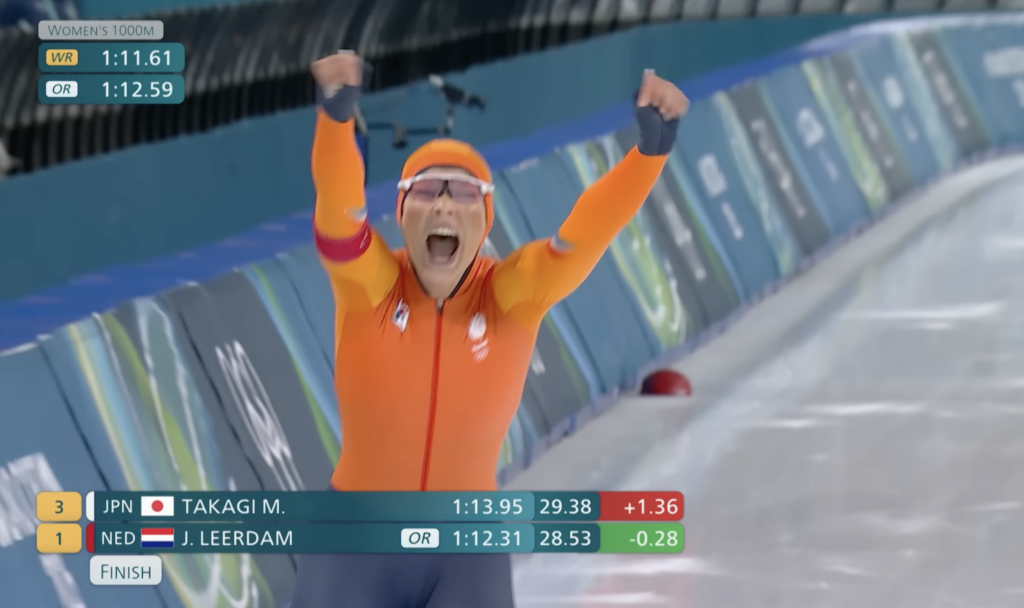
“There are too many signals that this is what I want, so I’m just going to do it.”
That’s what you wrote when you announced going solo on May 9th 2024.
In the pre-olympic year you chose to follow your heart and go your own way. You put your feelings over Dutch skate-rules, practises and “century old” traditions. You left “the system”, selected your own trainer and a fysio, and you stated your goal: the 2026 olympic gold medal in the 1000 metres sprint.
The Dutch establishment didn’t like your move and they put in a lot of effort to make that clear. Your make up was a problem, as was your fiancé, not to mention your social media behaviour. And then your deal with Nike and your ankle. The list goes on and on. Journalists were obnoxious, columnists toxic. Basically everything you did was scrutinised, then criticised and torn apart.
At the start of the olympics you announced to ignore the press until after that crucial 1000m race 2 days later. Contempt was your lot. Ignoring journalists, who the f*ck do you think you are? You chose ultra-focus, you wanted to stay in your zone.
And then the great Femke Kok rode a new olympic record just before your race. You saw it happen and must have realised that you had never been so fast on any European ice-ring in your life.
The Dutch sport-journalists noticed it for sure and crowned Femke Kok as the winner already, anticipating that you would not beat her time. You could almost hear a national relieve when they chose their hate over belief in your potential.
So off you were, on subpar Ice in that Italian sea-level arena. You needed to outgrow yourself to achieve your dream, with a big chunk of haters rooting against you. The pressure must have been intense. It was you against the clock, the black and white situation you prefer over a jury-sport.
And you did it.
That Gold Medal is the result of a well-thought-out approach that you believed in. It wasn’t just luck. You will forever be an inspiration to people, not only young girls, who chose to follow their heart. To hell with the haters. You called preparation an individual process that requires a tailored approach, and the gold medal proves you right. Your fame is for eternity. (And just maybe some of the brass will take notice.)
It’s the early 1990s when I meet Joey at a birthday party. He has a flashy job title and works at a large corporation. I, by contrast, am just starting out as a solo-entrepreneur. I’m young, inexperienced, but full of energy. I see endless of opportunities but also face many challenges. I have a couple of small customers, but Joey works on complex projects, managing big teams of consultants.
Joey wears expensive suits, drives a sleek company car, and always has a vague but confident answer ready. He is a senior-something on his way to the top. To him, everything is peanuts. Meanwhile I feel like I’m at the bottom of a deep, empty lake that is slowly filling up. I’m clinging to the fragile path that hopefully will take me upward. For me it’s a very hectic time.
We often speak, mainly at networking-events, but our relationship never grows into a true friendship. Our conversations touch on life, but mainly revolve around business, because that is Joey’s world. His worries are about budgets, promotions, and the service quality of his lease-company. I’m lying awake on how to make payroll for the two people I employ and whether I will spend Saturday night at a friend’s birthday or will be catching up on work. We stay in touch, though the frequency drops over the years.
Joey has a good career and makes it to deputy director of a business unit. He spends much of his time on the golf course and visits events where he mingles with high-ranking officials. He operates in a conceptual world I don’t recognise, but I’m deeply impressed. With my company I have survived the initial onslaught and am steadily building a modest, international tech-company. For Joey it’s still all peanuts, but I cherish the struggle and the fun with the people around me.
Out of the blue I get a phone-call. It’s Joey telling me that he has been suspended from his job. He considers this a good thing, as it finally gives him the opportunity to start his own business. For a split second I wonder if he needs some kind of help. But he immediately clues me in that this is not the case. What was I thinking? The call is to inform me about his new plans and he promises to show me that true entrepreneurship is nothing but peanuts.
A week later I meet him at a fancy networking-event where a new country-wide, semi-governmental, advertising campaign on startups is being presented. My company is part of the campaign and I’m very curious on how it is done. I mean, I have okay’ed the photo they have taken of me. And I know which quote of me they are going to use. But that’s it. Before the unveiling Joey finds me talking with an official from the city. He is all hyped up about his new company. “Big projects are already lined up”, he assures me, “and the rest will follow naturally”. Before I can tell him something about the campaign, he is already gone: “Have to work the room, meet important people, you know!”
In their ultimate wisdom the brilliants minds of the advertising agency have decided to prominently feature my face in the advertisements. In a magazine they hand out I’m featured back to back with an olympic gold medallist. I’m kind of embarrassed, as I basically only started a company, while that sporter has been training his ass off for at least 18 years. But my shame is quickly torpedoed as the spokeswoman announces billboards along highways and in busstops. A presentation on the screen shows my face in 6 x 3 metres on an advertising mast along the highway I literally daily use.
“That escalated rather quickly,” my colleague whispers.
“It certainly redefines distasteful,” I answer, while feeling my face turning red out of discomfort.
We have a good laugh about it, but also realise that the campaign is going to be much bigger than we anticipated.
“Which memo did we miss?” I ask my colleague, while thinking about all the meetings we have had about this campaign.
Before I can finish my thoughts, Joey is all over me. He suddenly acts like he is my best friend. My role in the campaign has clearly enhanced my status in his mind. He congratulates me exuberantly and invites me to a launch party celebrating his new venture.
A week later, I walk into the famous and outrageously expensive restaurant Joey has picked for his founding-event. It’s my first time in such a place and I feel quite intimidated by the atmosphere.
Joey opens the evening with an upbeat speech that is really funny, but forgets to explain what problem his company will be solving. Under the banner of “lean and mean,” he envisions quick growth, aiming at an organisation of ten senior consultants within two months. Joey clearly thinks big.
And with big I mean huge, as he tells about the company’s investors, the two new flashy offices and expensive lease-cars. “It’s all peanuts,” according to him. He is pretty negative about some former colleagues, and then takes a few jabs at guests and investors present. He introduces me as “the famous posterboy with that funny but empty startup”. It’s entrepreneurship according to Joey.
After diner he hands us a sponsored magazine that features him on the cover. Inside are several interviews with Joey about him, his car and the new corporate headquarters. It also features some articles with investors talking about Joey as if he is some kind of new corporate Gandhi. The package includes his business card that reads President & Senior Business Consultant.
Half a year later, we meet again. Place of action is the restaurant in the stadium of a professional football organisation that my company sponsors. We are not a huge contributor (yet), but are a prominent member of the business-club and have some visible brand-signage in the broadcast-area. I’m pretty proud of it and have high expectations. I’m there with some colleagues and a few customers. Joey is present with one of his consultants as he is thinking of joining the business-club as a junior-member. We actually have a good conversation on the challenges of starting a business.
Joey tells me that he already has seven people working in his organisation. I find that pretty impressive, but he is disappointed as it is – in his words – “clearly below target”. He explains that his company has too much work on hand, and not enough people as “great talent is hard to find and even harder to pay.”
I’m interested in the dynamics the investors create as we are thinking about tapping into some external finances. I ask him how it works with turnover, costs and deadlines. And I’m curious about the overhead involved with the reporting.
Joey looks at me with a tired face: “It’s heavy, you know. Really rough sometimes. The reports are straight-forward, but the financial deadlines are tough. It also feels wrong. We need to make a certain turnover threshold, before getting to the next round of funds. But making deals isn’t easy. Lucrative deals take time we don’t have. Because of the pressure we are operating on aggressive, yet unsustainable rates. I simply don’t have the margin to hire the senior talent I need. But more good consultants would mean I can realise a better margin. What comes first? The egg or the chicken?”
“Ah, that is easy,” I explain. “The first chicken is the mothership that you should cherish. It’s never about the seven eggs, all that matters is a healthy chicken. So how about cutting some costs, like closing one of those two office-locations. And maybe scaling back on cars.”
He laughs at me. “You always think like shopkeeper. That is so typical for you. Things are hard, so you scale down and cut costs. I understand where you come from and it makes a lot of sense. But scaling down gives prospects the wrong impression. They choose to be in business with winners and don’t like losers. Cutting costs is losing, you see.”
He points at the meal on the table. “You will always be like this. You are happy with a simple three course meal with some smalltime customers in an anonymous restaurant. It’s not what I want to be. You understand? The only way is up. And quickly. When you would scale down, I scale up.”
His punch makes me think.
My company saw life, struggling from day to day. Then we went from week to week and finally mode it to toddler, going from month to month. To make ends meet, the main driver was keeping costs under controle. We planned and debated a lot before spending money. We were not stingy, but frugal.
We just upped our standards to two months. Meaning that for the first time in our existence we had enough money to pay for all salaries and costs two months in advance. It was a luxurious feeling. Probably not comparable with Joey’s situation, but for my standards we were getting somewhere.
Moreover, I’m an introvert that can pretend to like people. I really don’t care what they say about my office. Or my car. Or my clothing. Or my brochure. I’m not a flamboyant type that gets energy from external sources. My happy place is a room without windows, where I can tinker with technology. And that of course has an influence on the decisions I make.
I find it quite an interesting and educational conversation with Joey. The first one I actually like. And if the devil plays with it, it will be our last conversation for a while.
Close to a year later, I learn that Joey is struggling to keep his company afloat. That’s not a shame, as starting your own business is hard. Keeping it going is even harder. He has closed his main office and the rumour mill talks about lay offs.
Two months later Joey’s most trusted consultant applies for a job with our firm. We don’t do consulting, so I refer him to a friend of mine. But from the conversation I learn that Joey is winding down, desperately trying to prevent an implosion.
No dishonour there, as that’s the risk of being an entrepreneur. Running your own thing is an everlasting fight. You are constantly puzzling on something: staff, money, innovation, taxes, regulations or whatever. Joey doesn’t call me about the final closure, I learn it through the corporate grapevine. It will take over four years before I run into him again.
It happens at a trade-fair.
With the telecoms-part of my company we have taken the gamble of renting a lot of square meters at specialised retail-fair. We literally spent weeks debating and calculating the whole event. Could we make it worth the investment? We have a really good product for chainstores. And some really good customers that will vow for us. It is a shitload of money, but in the end we decide to take the dive. So there we are. Ready to talk with customers, potential customers and basically everyone interested in our tech, because we are proud as hell.
We are promoting the network-solution that made us something of a national player in retail in The Netherlands. We also have made some small inroads in Belgium and Germany. And our feelers are scanning France and England. Compared to that ugly duckling we were years ago, we’ve grown up beautifully, but next to huge generic incumbents that dominate national markets (eg Deutsche Telecom, KPN and Belgian Telecom) we are just a tiny hardworking specialist. Customers see us as the funny bunch. The odd company where an attitude makes up for the lack of suits and ties. And we deliver quality, and are reliable. So we get away with it. We literally serve thousands of shops, restaurants, hospitals and other POS-locations (point-of-sale) in multiple countries.
Our exhibition stand is big, but functional. It has a central presentation area with some intimate meeting-booths in the corners. And really good hand brewed coffee, like we also have at our offices.
I’m cleaning a table with a damp cloth. Some of my colleagues are in conversations with prospects while an account-director is awaiting a delegation from a supermarket-chain. With a couple of hundred high volume stores it’s big organisation, but nothing we can’t handle. I co-designed the networking solution and the presentation, but will not join the meeting.
Totally unexpected Joey walks onto our stand, sharply dressed as usual. I say “hi”, but he doesn’t recognise me. And why should he? The last time we met, I was in software, had more hair and carried 20 kilos more weight. He continues to shake hands with my colleague. I hear him introducing himself and explaining that he is consulting the supermarket-chain. He knows that he is early and has to wait a bit for the formal delegation, including the procurement director. I walk up to him and greet him again. Now he does recognise me. I point to the booth I just cleaned and propose to have a cup of coffee while he waits for his client.
I get two coffee and after I sit down Joey immediately starts talking. He is still all business. His business, so to speak. “Complex projects in IT & Telecom these days,” he says. He notes that I “kind of” work in telecom too, as he points to the cloth that I used to clean the table.
“So, what are you doing here?” I ask him, concealing that I overheard his introduction to my colleague.
He explains the huge project he is working on for the supermarket-chain. To him it’s all peanuts, you get the idea. It involves payment-terminals and telecom-connections for hundreds of locations, in multiple countries. He explains it grotesque, with so much bravoure and confidence that I would have believed he all masterminded it … if I hadn’t been involved in the design of the network myself. I basically know every gritty detail as I sat in on more than a few project-talks and never encountered him or even his name. I suspect him to be a new manager on some part of the project.
I contemplate if I should tell him, but don’t get to it, as he elegantly shifts the subject to his former venture. His solution for the supermarket-chain “is cutting edge, as of course is everything he does, but sometimes the timing is off.” I see some pain in his face as he explains why his former company didn’t fly: “You know, I was too early. The market simply wasn’t yet ready for my innovative approach.”
“Yeah that might be it”, I hear myself responding. Out of the corner of my eye, I see the delegation of the supermarket-chain shake hands with my colleagues.
Joey smiles at me, then finishes his coffee.
Our account-director approaches our booth and informs us that everyone is present. “Can I take Joey boss? His colleagues are already waiting in the meeting-room upstairs.”
“Boss?”, Joey says, while he throws me a strange look.
I chuckle as I stack the empty cups: “Sure, no problem. Just know that this guy is brilliant, yet allergic to peanuts.”
There are countless unicycle competitions worldwide every year, both regional and national, even intercontinental. Every two years there is a world championship. In 2026, it will be held in Austria, and the organizers expect between 2,500 and 3,500 participants. These are fanatical multicultural events.
Some European countries spread the competitions throughout the year and across the country, so that there is a competition somewhere every month. The great thing about this is that you get to see different parts of the country in different seasons. Germany is one such example, with competitions in all seasons of the year.
The French Unicycling Championships are sometimes referred to as a mini world championship. This is mainly due to the format. The French approach it as a mini world championship and pack all disciplines into 10 jam-packed days. Countless athletes gather in one region and jump on their unicycles to perform stunts, race, dance, and climb.
My daughter is hooked and that brings me to a lot of competitions and events. She has also developed a theatershow which add a different layer to the instrument mostly associated with circus. For her the unicycle is topsport, a way of life and I slowly start to understand what she means.